By : Arvind Bhagwath
- 5 Headed Serpent ( Hindu and Egyptian Civilization)

2. Ahira-Budhnaya is also called Ohi-bridna or Uro-boros. He is the king of the Nagas. Originating in ancient Egyptian iconography, the ouroboros entered Western tradition via Greek magical tradition and was adopted as a symbol in Gnosticism and Hermeticism and most notably in alchemy. Ahir Budhnya, the benefic serpent of the depths of the Atmosphere, symbolizes fertility, kundalini energy, and need for seclusion that is experienced in this nakshatra.

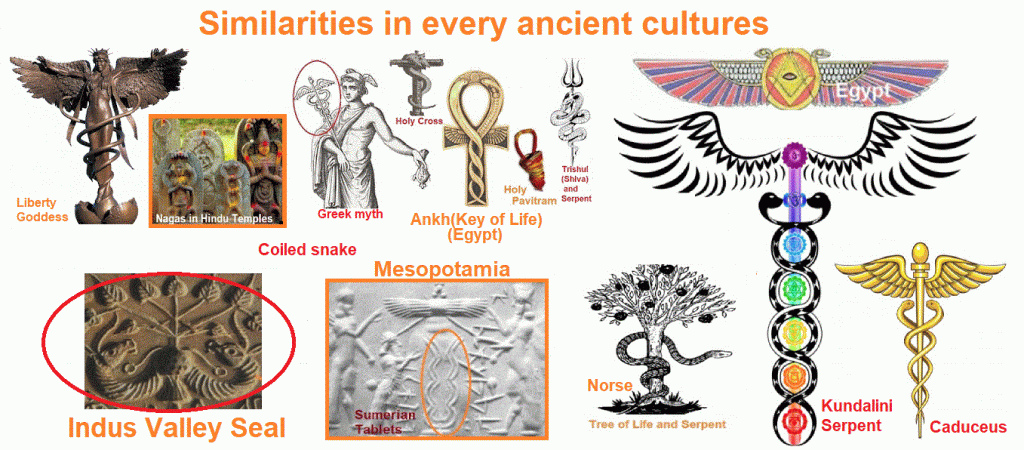
3. Symbolism of the Kundalini serpent(Channel to Moola – The Root) is present in every ancient mythology.
4. Samudra Mantan (Axis Mundi) parallels with ancient Egyptians.

5. Yogic Postures in Ancient Egypt.


6. Krishna ( Hindu) and Hercules ( Greek Mythology Parallels) – Similar astrological allegories in different cultures.


7. Daksha with RAM head(Aries) is creator God in Hindu mythology and his counter part in Egypt is the creator god Khnum(shown with RAM head as below)


8. Perseus and Parsu
The word Persia has its origins from Old Persian word “Parsu-wash”(Axe-Cult). In the Greek myth, Parsu is referred as Perseus(Demi God) who beheaded Medusa and similarly we have Parshuram(RigVedic Sage and Demi God) in Hindu mythology who beheaded Renuka.

9. Ha-ruw/Ha-re/Horus(Egyptian), Helios(Greek) with Hari ( Hinduism).

10. Cygne constellation can be identified as swan. In Hindu mythology we have Goddess Saraswati in Swan along with musical instrument(Lyre constellation).Goddess Saraswati represents goddess for music and wisdom in Hindu myth.


11. Shishumara Chakra


12. Flood myth or deluge myth is a narrative in most of belief system in which a great flood, usually sent by a deity or deities, destroys civilization, often in an act of divine retribution
Reference : https://en.wikipedia.org/wiki/List_of_flood_myths


13. Ṛta has been compared to similar ideas in other cultures, such as Ma’at (Cosmic Order) in Ancient Egyptian religion, Moira and the Logos in Greek paganism, and the Tao. The word dharma has roots in the Sanskrit dhr-, which means “to hold”or to support Rta(Law/Cosmic Order) or Ma’at. In Classical Sanskrit, and in the Vedic Sanskrit of the Atharvaveda, the stem is thematic: dhárma- (Devanāgarī: धर्म). In Prakrit and Pāli, it is rendered dhamma.
Reference : https://en.wikipedia.org/wiki/Maat


14. Feather being light in weight, it was ancient symbol to show emptiness(free from sin, lust, desires, misdeeds etc.) and represented as the symbol of truth, law, order and justice in several ancient civilization including Egyptians.
In ancient hieroglyphics(before the origin of formal human writing), the best way to represent this emptiness was symbol of feather since it does not have any weight and for Egyptians, this symbol showcased soul that is free from sin, lust, desires etc. and was placed on various deities of ancient Egypt and several civilizations took this representation later that you can refer. You can also find deities with feather on crown even in Mayan, Sumerian cultures too.

15. Yamah and the related Sanskrit Yama are interpreted as “the twin,” perhaps reflecting an Indo-Iranian belief in a primordial Yama and Yami pair.We can locate parallels between Avestan Yima and Sanskrit Yama, for instance, Yima was the son of Vivaŋhat, who in turn corresponds to the Vedic Vivasvat, “he who shines out”, a divinity of the Sun. Both Yamas in Iranian and Indian myth guard Hell with the help of two four-eyed dogs ( Canis Major and Canis minor constellations).In Norse mythology, Ymir was the primordial being, a giant(ORION constellation) and together with Ymir a primeval cow Auðumbla(TAURUS constellation) was born and her milk fed Ymir. The Giant Ymir then created the first male and female from the pits of his arms. Their names were Ask and Embla, the Nordic equivalent of Adam and Eve or Yama and Yami pair in Hindu Mythology (corresponds to Gemini Constellation)

16. Marduk is similar to Vedic Maruts.

17. Navel of Cosmos/Lingam/Axis Mundi concept.


18. Similar Astrological Allegories of Solar and Lunar dynasty in almost every ancient cultures.


19. Double headed mythical Bird


20. Sun God and parallel rituals(Drawn over Chariot/Barge)


21. Pashupati and Master of Animals

22. Sky God in ancient cultures.


23. God of Death/War/Underworld

24. Concept of Heaven and Underworld

25. Creation Myth ( Egyptian and Hinduism)

26. Cosmic Cow

Reference on Heaven, Hell and Orion :


Thank you.
Author : Arvind Bhagwath
Technology Consultant, Globe trekker and Blogger. Interest in study of ancient Star Myths — https://ancientstarmyths.blogspot.com/
 ancientcult.home.blog
You must be logged in to post a comment.